Home

The mission of the Charles J. Connick Stained Glass Foundation, Ltd. is to promote the true understanding of the glorious medium of color and light and to preserve and perpetuate the Connick tradition of stained glass.


News and Events

ALERT! It has come to the attention of the Connick Foundation that certain stained glass firms are offering “free” advice to churches, which promotes needless and costly re-leading of their windows.  A word of warning.

Honorary Director Peter Cormack’s stellar book, Arts & Crafts Stained Glass, may be found here, along with a review by the Foundation’s former president Albert Tannler. A review by trustee of the Scottish Stained Glass Trust Dr. Elizabeth Cumming may be found here.

Inquiries regarding the records of the Charles J Connick or Connick Associates Studios should be made directly to the Connick Collection of the Boston Public Library Fine Arts Department or the Connick Collection of the Massachusetts Institute of Technology Rotch Library.

The Boston Public Library holds the extensive document and design archives of the Connick Studio, as well as panels, photographs and other studio artifacts. Many Connick designs are available to view online. To examine correspondence, files or other pieces of the collection, please contact the Fine Arts Department 617-859-2275; fineartsref@bpl.org.

The Connick Collection at MIT’s Rotch Library has been digitized and is accessible online. This collection includes job files, which are a good starting point for researching your windows. To view original items, please contact MIT Distinctive Collections to make an appointment.

The Connick Foundation mourns the passing of Director Lance Kasparian in March, 2026. We greatly his countless contributions and we will sorely miss his profound scholarship.

The Charles J. Connick Stained Glass Foundation, Ltd.

Orin E. Skinner, Founder
DIRECTORS AND OFFICERS
Marilyn B Justice, Acting President    Theresa D. Cederholm     Judith G. Edington
Jeremy J.H. Grubman    Charles S. Hayes    David A. Martland
Ann Baird Whiteside
Kristin Knudson, Clerk
HONORARY
Peter D. Cormack    Jonathan L. Fairbanks    Elizabeth B. Johnson

Image

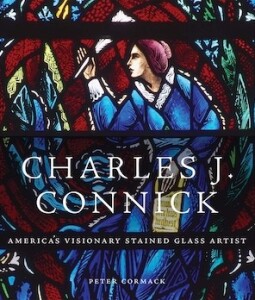
Book from Peter Cormack – Charles J. Connick: America’s Visionary Stained Glass Artist

Charles J. Connick: Americas Visionary Stained Glass Artist by Peter Cormack

Charles J. Connick: America’s Visionary Stained Glass Artist
by Peter Cormack

Peter Cormack, Charles J. Connick: America’s Visionary Stained Glass Artist Available from Yale University Press.

Read Peter’s blog: https://yalebooksblog.co.uk/2024/05/15/charles-j-connick-stained-glass/

For some years, British art historian Peter Cormack has been researching the life and work of Charles J. Connick, the foremost American stained glass artist of the twentieth century. Here is a brief summary of his new book, published in the USA in 2024:
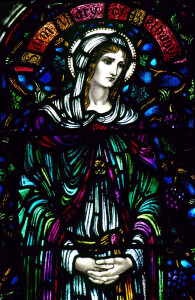
Detail of window (1915) at Congregational Church, Marion, MA

Detail of window (1915) at Congregational Church, Marion, MA

Although Charles J. Connick (1875-1945) primarily worked in stained glass, this account of his life and work is wide-ranging and focuses on him not only as artist and craftworker but also as a significant twentieth-century cultural figure in America, whose friends included the poets and writers Robert Frost, Sherwood Anderson, Joseph Auslander and John Holmes, as well as leading architects such as Ralph Adams Cram, Charles Maginnis and Harold Whitehouse. His patrons ranged from Delia McCabe, a domestic servant in New York City, to some of the most celebrated names in US business and industry (the Heinzes of Pittsburgh, the Procters of Procter & Gamble, the Crockers of San Francisco and the daughter of the founder of Pinkerton’s Detective Agency, et al.) and notable political figures, such as Boston’s notorious Mayor James Michael Curley.
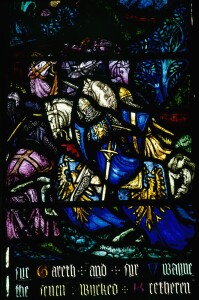
Detail of Holy Grail window (1919) at Procter Hall, Graduate College, Princeton, NJ

Detail of ‘Holy Grail’ window (1919) at Procter Hall, Graduate College, Princeton, NJ

In many ways Connick’s life-story is quintessentially about the ‘American Dream’. Born into poverty in rural Pennsylvania and having received very little formal education, he rose to become the undoubted leader of his art in America, with an international reputation and the award of honorary degrees from Princeton and Boston universities, as well as medals and other distinctions from international exhibitions and professional institutions.

In its examination of Connick’s career as a stained glass designer and master-craftsman, the book encompasses the profound influences of medieval art – especially the windows of the great European Cathedrals (Chartres, Paris, Rheims, Canterbury, York, etc.) – and of the British Arts & Crafts Movement, with which he had close and fruitful connections. Yet Connick was decidedly not – as he has sometimes been wrongly characterised – a ‘Gothic Revivalist’. He was committed to a modern vision of his chosen art form and, in his mature works, developed a wholly convincing idiom in design and technique that was boldly graphic and dynamic while also enriched by traditional technique and materials.
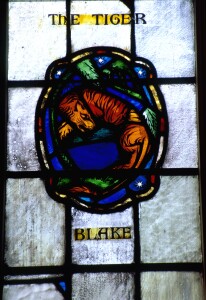
William Blakes poem Tiger, window

William Blake’s poem ‘Tiger’, window (1928) at Peirce Hall, Kenyon College, Gambier, OH

He was especially concerned to create windows that would resonate for his contemporaries, and introduced specifically American themes never previously represented in stained glass – notably at Heinz Memorial Chapel at the University of Pittsburgh. An avid reader of classic and modern literature, Connick loved to depict literary subjects, whether on an epic scale, as at Princeton University Chapel, or on the more intimate and domestic scale of his glazing scheme at Kenyon College in Gambier, Ohio.

Amongst the many ecclesiastical commissions that were undertaken in his studio (at 9 Harcourt Street in Boston’s Back Bay neighborhood), which was organised in accordance with Arts & Crafts precepts, are major glazing schemes for St John the Divine Cathedral and St Patrick’s Cathedral in New York and for Grace Cathedral in San Francisco. Connick himself was a charismatic communicator about the history and practice of his craft: he lectured throughout the country and his 1937 book Adventures in Light and Color, widely recognised as a classic of craft literature, was praised by Lewis Mumford, who spoke of the ‘ecstatic brilliance’ that Connick’s windows had brought to American churches.
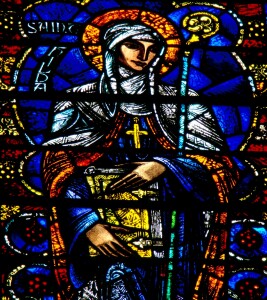
Detail of St Hilda of Whitby (1933) window at Grace Cathedral, San Francisco, CA

Detail of ‘St Hilda of Whitby’ (1933) window at Grace Cathedral, San Francisco, CA

Connick’s stained glass can be seen throughout the United States, in religious buildings, universities, schools and libraries, business offices and in private homes and many examples are illustrated in the book. They are, in the author’s words, ‘among the nation’s greatest cultural treasures’.

Peter Cormack MBE, FSA, HonFMGP, is the former Curator of the William Morris Gallery, London, where he researched and organised many exhibitions on William Morris and the Arts & Crafts Movement. He is a Fellow of the Society of Antiquaries, Vice-President of the British Society of Master Glass-Painters, Honorary Brother of the Art Workers Guild and Honorary Curatorial Adviser for William Morris’s country home, Kelmscott Manor in Oxfordshire. His books include Arts & Crafts Stained Glass (Yale University Press, 2015) and The Stained Glass Work of Christopher Whall (Charles J. Connick Foundation & Boston Public Library, 1999).
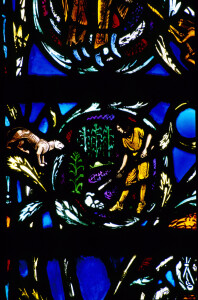
Pioneer Farmer and Cougar detail of window (1937) in Heinz Memorial Chapel, Pittsburgh, PA

‘Pioneer Farmer and Cougar’ detail of window (1937) in Heinz Memorial Chapel, Pittsburgh, PA

This book is listed on Christies “The Best Art Books to Look Out For” in 2024.
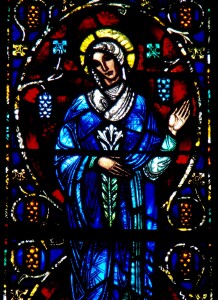
Virgin Mary detail of window (1931) at Church of the Covenant, Erie, PA

‘Virgin Mary’ detail of window (1931) at Church of the Covenant, Erie, PA
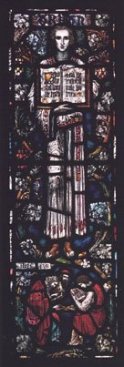
2025 Annual Letter

2025, which has marked the 150th anniversary of Charles J. Connick’s birth (and the 80th of his death), has been a particularly significant and productive year for the Foundation. One of our principal projects has been the planning and organization of a lecture-tour in October this year by Peter Cormack MBE FSA, which celebrated the publication last year of his book Charles J. Connick, America’s Visionary Stained Glass Artist (Yale University Press, 2024). Peter, who is an Honorary Director on the Foundation’s board, lectured to enthusiastic audiences in New York City at the Cathedral of St John the Divine and the Harvard Club, and in Boston at the Athenaeum and the Chilton, Tavern and St Botolph Clubs. He also signed copies of the book, which has received very positive reviews in various journals and magazines in both the USA and the UK. The most recent, written by the eminent stained glass historian Julie L. Sloan, appeared in the current (Fall 2025) issue of Nineteenth Century, the magazine of the Victorian Society in America. It describes the book as “a thorough and masterful telling of Connick’s artistic journey and legacy” and “perhaps the best biography of an American stained-glass artist to date.” Ms. Sloan’s review concludes that “it provides a format upon which all future biographies of American stained-glass artists should rely.” Richly illustrated in full color and with an authoritative text, this pioneering and very readable account of Charles J. Connick’s career is the fruit of many years of the author’s scholarly research, with which the Foundation has been closely associated since the 1990s.

Over the years, the Foundation has been actively involved in preserving examples of the Connick studio’s stained glass. In collaboration with the City of Newton, MA., we have ensured that the Poetry windows (illustrating verses by Emily Dickinson and Robert Frost) which Charles J. Connick made for the former Newtonville Public Library, have been expertly conserved by Roberto Rosa of Serpentino Stained Glass, Needham, MA., prior to their re-installation in Newtonville’s new Cooper Center in December. The gift of Charles J. Connick and his wife Mabel Coombs Connick, the two windows were originally dedicated in December 1939 at a ceremony attended by the artist and his friend Robert Frost. Illustrated articles by Peter Cormack and by Roberto Rosa on the history and conservation of these windows have been featured in the special Centenary Issue of The Journal of Stained Glass (Volume 48), published by the British Society of Master Glass Painters.

After the Foundation was given Connick’s eleven windows, made in 1926 for the former Play Room of Cincinnati Children’s Hospital windows, we began exploring the possibility of donating them to a suitable museum. The eleven windows, which depict scenes and characters from the world of children’s literature, are superb examples of Connick’s ‘Arts & Crafts’ style of secular glazing. We are hopeful that they will soon find an appropriate new home. From time to time, the Foundation is given or bequeathed items associated with members of the Connick studio. Karl Heinz, a long-time supporter, left the Foundation in his will a number of items belonging to his grandfather Peter Hansen (1871-1950), who was one of Charles J. Connick’s most skilled and valued co-workers. The collection includes sketchbooks and some stained glass pieces. The Foundation is in the process of researching and making an inventory of this important and generous donation.

The Connick Foundation’s mission is to educate the general public to the vitality that is so richly embodied in the finest stained glass. It is an art that, at its best, communicates profound spiritual, emotional and intellectual qualities. Peter’s illustrious book Charles J. Connick, America’s Visionary Stained Glass Artist, now places Connick at center stage, not only amongst the stained glass community but also for the general public.

Your contributions this year will go to restoring the eleven Connick windows that Cincinnati Children’s Hospital kindly gave to the Connick Foundation.

We are abundantly grateful to all of you who so kindly and generously contribute to the Connick Foundation’s success.